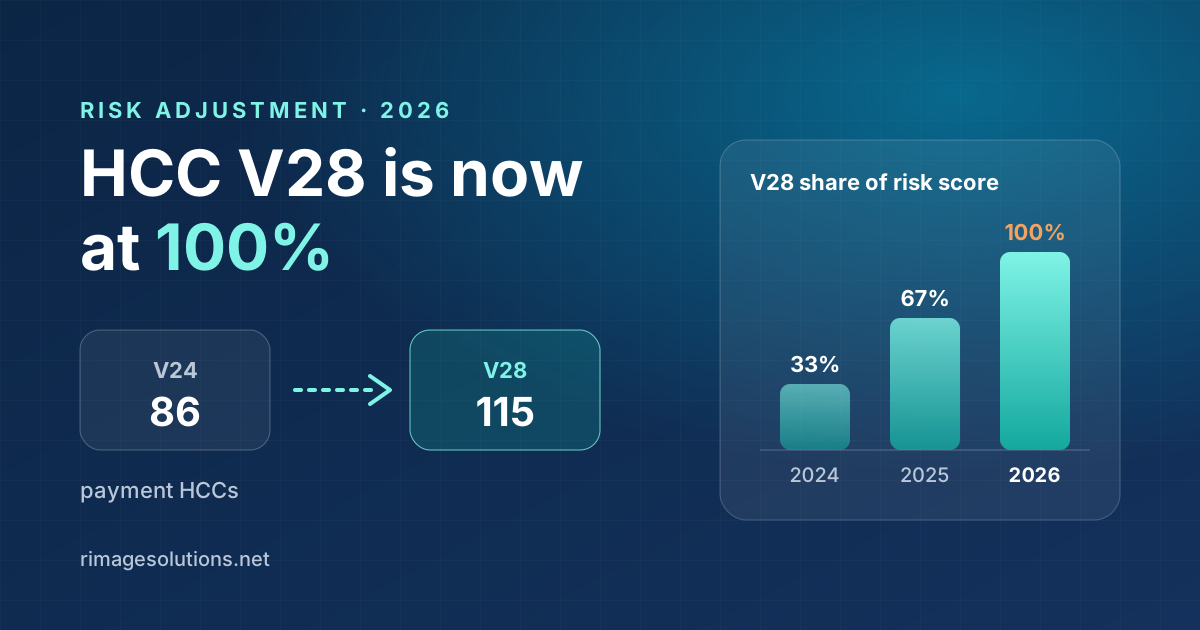
Payment year 2026 is the first year Medicare Advantage risk scores are calculated entirely on the 2024 CMS-HCC model, better known as V28. The three-year phase-in that began in 2024 is complete, and for MSOs and IPAs carrying risk, the transition is no longer a blend you can average your way through.
The phase-in is over
CMS introduced V28 for payment year 2024 and phased it in over three years: risk scores were based one-third on V28 in 2024, two-thirds in 2025, and fully on V28 in 2026, as CMS described when it finalized 2026 payment policy and "completing a three-year phase-in" of the updated model. Because payment years look back at the prior year's diagnoses, the documentation your providers captured during 2025 is what drives 2026 revenue.
What actually changed
V28 is not simply V24 with new numbers. The model was rebuilt around clinical specificity and fewer discretionary diagnoses:
- More categories, fewer paying codes. The number of payment HCCs rose from 86 to 115, but roughly 2,200 ICD-10 codes that paid under V24 no longer map to any payment HCC.
- Conditions that dropped out. Examples include protein-calorie malnutrition, unspecified angina, and atherosclerosis of the extremities without complications. Diagnoses that once supported a large share of recapture programs now carry no risk weight.
- Diabetes is flattened. Diabetes with and without complications now carries the same coefficient, so "upgrading" a diabetes diagnosis no longer changes the score.
- Heart failure is tiered. Heart failure is split into severity levels, which rewards precise documentation of type and acuity.
The practical result is RAF compression: many populations score lower under V28 for the same patients and the same care, especially groups that relied on the conditions that lost their weight.
Audit scrutiny is rising at the same time
In May 2025, CMS announced a major expansion of Risk Adjustment Data Validation (RADV) audits, including plans to audit all eligible Medicare Advantage contracts each year. Health plans facing recoupment risk will push documentation expectations down to their delegated MSOs and IPAs. Every HCC that drives payment should be supported in the medical record, with evidence that the condition was monitored, evaluated, assessed or treated.
A six-step checklist for MSOs and IPAs
- Re-map every suspect and recapture list to V28. Retire conditions that no longer pay so care teams stop chasing them.
- Prioritize by coefficient and hierarchy. Focus outreach where a documented condition actually changes the risk score.
- Retrain providers on specificity. Heart failure type and acuity, complications that move a condition to a higher category, and current status of chronic conditions.
- Audit charts before CMS does. Sample high-value HCCs each quarter and confirm the record supports them.
- Model the financial impact per contract. Compare 2025 and 2026 RAF trends against each health plan agreement and budget.
- Close the loop with health plan data. Reconcile plan-reported risk scores and encounter data with your own records every month.
How Rimage helps
CareAnalytix brings CMS, health plan, EHR and claims data into one place, flags suspected and recapture-due conditions under the current CMS-HCC model with evidence for clinician review, and reports MRA, MLR and RAF trends for every risk contract. Our coders and data abstraction team can support chart review for HCC and audit readiness.
See your population under V28
CareAnalytix re-maps suspect and recapture lists to V28, ranks gaps by coefficient and models RAF impact contract by contract.
Sources
- CMS: CMS Finalizes 2026 Payment Policy Updates for Medicare Advantage and Part D Programs (April 7, 2025)
- CMS: CY 2026 Risk Adjustment Implementation Memo
- HCC Buddy: CMS-HCC V28 changes, V24 vs. V28 comparison
- Ropes & Gray: CMS Announces Significant Changes to RADV Auditing Efforts (May 2025)
This article is for general information and is not legal, coding, billing or compliance advice.