Denials keep rising, staff are stretched, and every vendor now promises AI. The useful question is not whether to use AI in the revenue cycle, but where it reliably helps and where experienced people still make the difference.
Source: Experian Health, State of Claims 2025.
Where AI earns its place
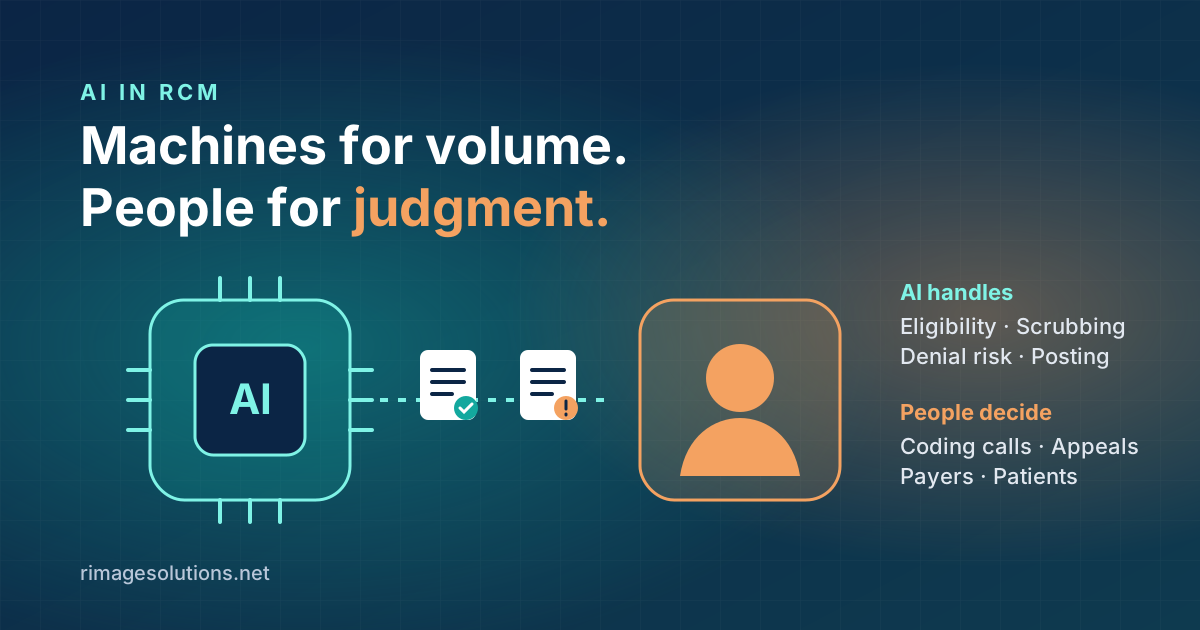
AI performs best on work that is high-volume, rules-heavy and repetitive, where patterns in past claims predict future outcomes:
- Eligibility and benefits checks run automatically before every visit, with only the exceptions routed to staff.
- Claim scrubbing catches coding, modifier, demographic and payer-rule errors before a claim leaves the building.
- Denial prediction scores each claim for risk so high-risk claims get a second look first.
- Payment posting auto-posts ERA/835 remittances and flags underpayments and variances.
- A/R prioritization ranks follow-up by likelihood to pay rather than by age alone.
- Document intelligence pulls key data from faxes, PDFs and scanned records.
- First drafts of appeal letters and coding suggestions, ready for expert review.
Where humans still win
Some work depends on context, accountability and relationships that a model cannot own:
- Final coding decisions where documentation is ambiguous or compliance risk is high.
- Appeal strategy for high-dollar and medical-necessity denials, including peer-to-peer reviews.
- Payer relationships: escalations, contract interpretation and recurring-issue resolution.
- Patient conversations about balances, payment plans and financial assistance.
- New and changing rules that are not yet reflected in historical data.
- Sign-off and accountability for anything that reaches a payer, a patient or an auditor.
Guardrails that make AI safe to use
- Human in the loop for coding, clinical and financial actions.
- Explainability: staff should see why a claim was flagged, not just that it was.
- Privacy: PHI protected under HIPAA and a BAA, and never used to train public models.
- Monitoring: track accuracy over time, because payer behavior changes.
How to start
- Pick one high-volume step, such as eligibility or claim scrubbing, and baseline its error and denial rates.
- Automate the routine cases and route exceptions to your most experienced staff.
- Measure what matters: first-pass claim rate, denial rate, days in A/R and cost to collect.
- Expand step by step once results hold for at least a full billing cycle.
How Rimage helps
Rimagination combines AI claim scrubbing, denial prediction, automated eligibility, smart posting and A/R prioritization in one platform, and our BPO team handles the exceptions and judgment calls, so you get the speed of automation with people accountable for the results.
Put AI to work on your claims
Rimagination builds AI into every step of the claim, with your staff confirming the decisions that matter.
Sources
This article is for general information and is not legal, coding, billing or compliance advice.